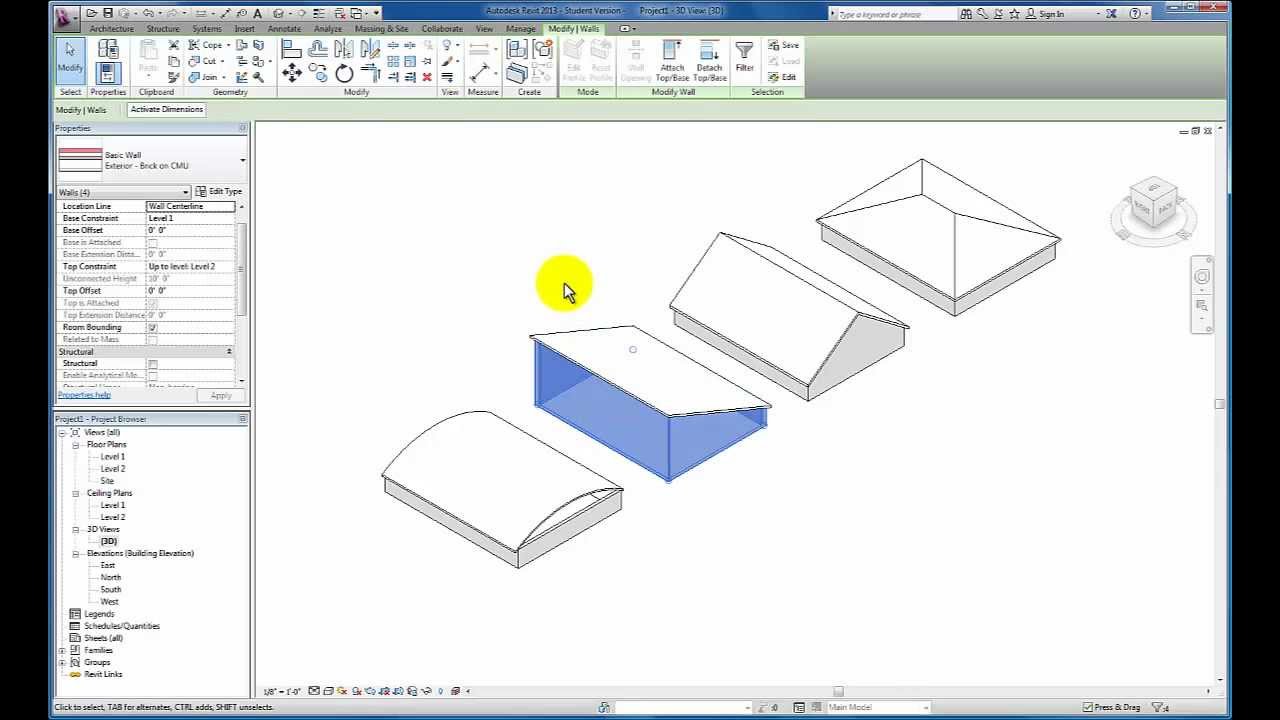
To change the slope definition of a line select the line and on the properties palette click defines roof slope.
Pick which walls set slope roof revit.
Select each boundary line and set the value in properties or in option bar.
You can then change the slope value.
In the example the lines at either end are given the defines slope property and the slope was set to match the falls of the roof above which is 30degrees in this instance.
Select each boundary line and set the value in properties or in option bar.
You can set an overhang on roofs created with pick walls.
You can then change the slope value.
In the drawing area highlight an entry wall.
When a roof line is set to slope defining this symbol appears adjacent to it.
Create a sloped roof in revit step 1 draw your roof step 2 define the slope.
Much like roofs you can use the defines slope property to control the slopes of your soffit under a gable or similar angled roof construction that overhangs the supporting wall.
Use pick walls if you want the roof to automatically adjust when walls are moved.
Specify slope defining lines.
Sketch or pick a closed loop for the roof.
Modifying revit roof slopes to change the roof from a gable roof to hip roof go into the sketch options select all boundary lines and turn on the defines slope parameter note as a default your roof will have a slope of 30 degrees on all boundaries and form a hip roof unless you change the slope designation in the sketch mode per boundary line.
On the draw panel click pick walls.
4 activate overhang on picked walls roofs.
5 activate overhang on picked walls roofs.
On the options bar for overhang enter 600 and select defines slope.
Specify slope defining lines.
When a dashed line is displayed on the exterior of the wall press tab to select the chain of walls and click to place the roof lines.
Sketch or pick a closed loop for the roof.