Finally the effect of plastic anisotropy on the puckering behavior in the spherical cup deep drawing process is investigated.
Plastic anisotropy in sheet metal forming.
Planar anisotropy if by performing experiments on the sheet it is found that the measured r value is unchanged with orientation the sheet is said to have planar anisotropy.
It is shown that the neglect of the anisotropy in the simulations leads to inaccurate results.
A general elasto plastic finite element formulation based on incremental deformation theory for planar anisotropy and its application to sheet metal forming int.
If r 1 then the sheet is of course isotropic 9 22 2015 39 40.
Anisotropic one as accurately as possible 1 11.
The numerical results are compared to experiments.
Plast 15 1 1999 pp.
More often however the type of plastic anisotropy is characterized by different strengths in different directions in the plane of the sheet as well which is called planar anisotropy.
For the first time testing methods for plastic anisotropy of round bars and tubes are included.
A general elasto plastic finite element formulation based on incremental deformation theory for planar anisotropy and its application to sheet metal forming int.
The analysis is based on the deformation theory and hill s theory of plastic anisotropy.
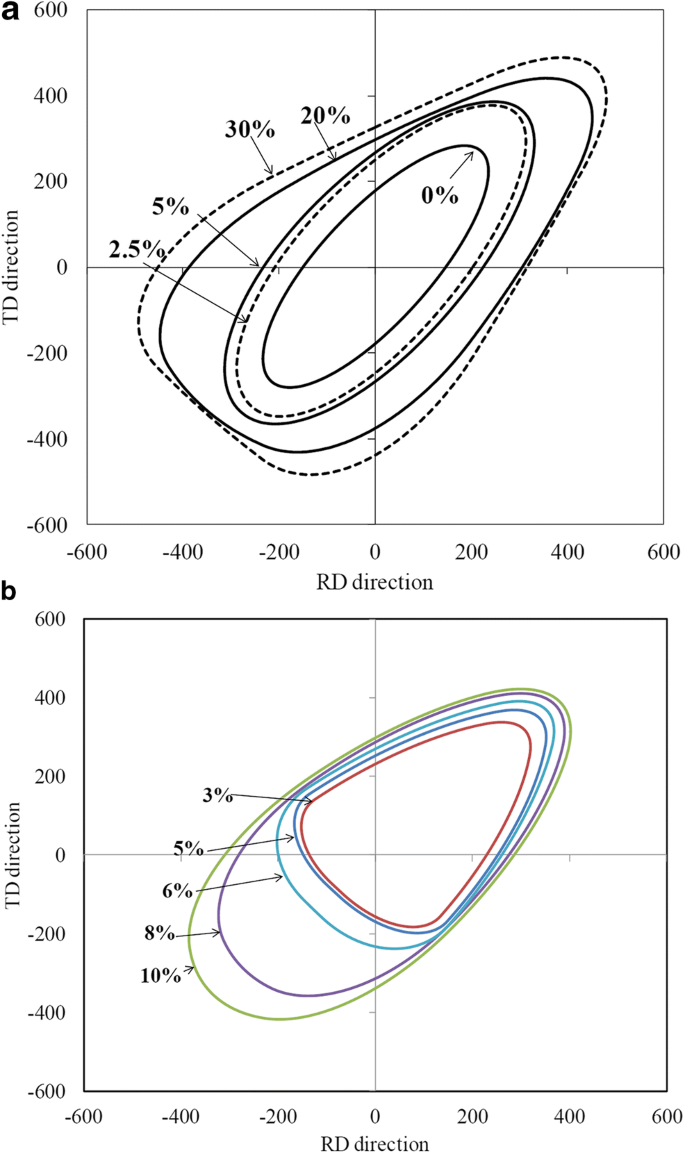
A stress points forming contours of plastic work of aluminum alloy sheet 6016 o compared with the yield loci.
The computer simulation of the sheet metal forming processes needs a quantitative description of the plastic anisotropy by the yield locus.
From the results of the finite element analysis it is shown that puckering behavior of sheet metal is largely affected by plastic anisotropy.
Memorandumului 28 400114 cluj napoca romania.
Advances in anisotropy of plastic behaviour and formability of sheet metals.
A large chapter is devoted to formability testing both for bulk metal and sheet metal forming.
A profound survey is given of literature about yield criteria for anisotropic materials up to most recent developments and the calculation of forming limits of anisotropic sheet me tal.
Numerical analysis is carried out in order to investigate the influence of plastic anisotropy on sheet metal forming processes such as stretching and deep drawing.
The type of plastic anisotropy usually desired in sheet metal forming is that the sheet is isotropic in the plane and has an increased strength in the thickness direction which is nor mally referred to as normal anisotropy.